
SSB Interview Complete Guide 2027: 5-Day Process Explained Step by Step
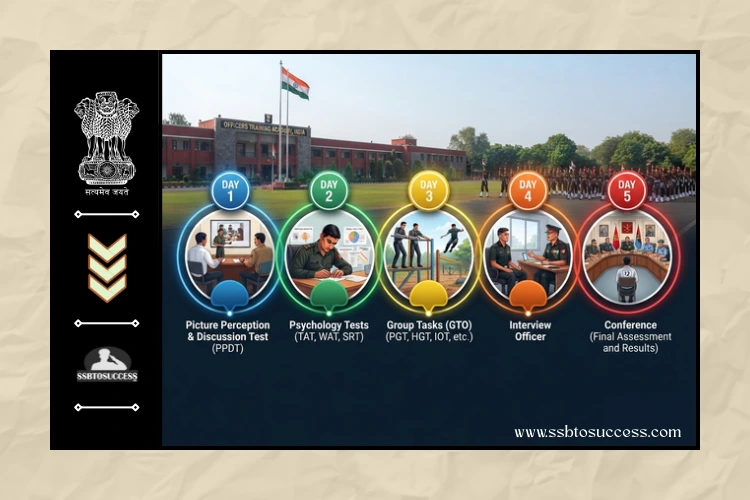
The SSB interview process 2027 is a multi-day assessment for candidates seeking officer entry into the Indian Armed Forces. It uses a two-stage selection structure: candidates first complete Stage I screening; those who qualify continue to Stage II, which includes psychological tests, Group Testing Officer (GTO) tasks, an interview, and a conference.
The exact timetable and Stage I format can vary by entry and selection centre. Use this guide to understand the process, then follow the instructions in your call-up letter.
Quick answer: SSB generally runs across five testing days. Stage I screening takes place first. Candidates who qualify continue through Stage II assessments and a final conference. Reporting may take place separately, and the order of some Stage II activities can vary.
What does the SSB interview assess?
The Services Selection Board assesses a candidate through multiple techniques, including psychology tests, group tasks, and a personal interview. The UPSC’s NDA and NA (II) 2026 notification describes Stage I as OIR tests and PP&DT, followed by Stage II assessments over four days. It also states that the candidate is assessed holistically by the Interviewing Officer, GTO, and psychologist, without separate weightage for each individual test. UPSC NDA and NA (II) 2026 notification
SSB is therefore not a conventional interview with one question paper and one score. Assessors observe your responses across different settings. The purpose of this guide is to explain the process—not to suggest that a memorised script can guarantee a recommendation.
SSB interview process at a glance
| Day | Usual focus | What candidates may encounter |
|---|---|---|
| Reporting | Arrival and instructions | Document checks, accommodation or movement instructions, and candidate briefing |
| Day 1 | Stage I screening | The test format stated in the call-up instructions; recent official UPSC guidance describes OIR and PP&DT |
| Day 2 | Stage II begins | Psychological tests; other activities may be scheduled according to the centre |
| Day 3 | Stage II continues | GTO tasks and, for some candidates, the personal interview |
| Day 4 | Stage II continues | Further GTO tasks and/or personal interview |
| Day 5 | Conference and result | Board conference and communication of the outcome |
This is a general orientation, not a guaranteed timetable. The official notification describes Stage II as taking place over four days, but it does not assign every activity to a fixed calendar day. Reporting arrangements may also differ. Follow your call-up letter and instructions at the centre.
Before the first test: reporting and document checks
Your call-up letter should state where and when to report, what documents to bring, and any other entry-specific requirements. Read it carefully before travelling. Keep required original documents and requested copies organised, and contact the selection centre through the official channel if an instruction is unclear.
Candidates may receive a briefing about the schedule, conduct, and centre rules. Reporting formalities are not necessarily counted as one of the five testing days, so confirm the dates in your own instructions.
Day 1: Stage I screening
Stage I determines which candidates continue to Stage II. According to the UPSC NDA and NA (II) 2026 notification, Stage I comprises the Officer Intelligence Rating (OIR) tests and the Picture Perception and Description Test (PP&DT). Candidates are shortlisted based on their combined performance in those tests. UPSC notification
The Indian Army has also published an official video titled “SSB Computer Stage 01,” explaining computer-based Stage 01 testing. The format communicated to candidates may depend on the applicable entry and instructions, so check the latest call-up information rather than assuming that every centre uses an identical format. Official Indian Army Stage 01 video
If you qualify in Stage I, you continue to Stage II. Candidates who do not qualify are released according to the centre’s instructions.
Days 2–4: Stage II assessments
Stage II combines psychological tests, GTO tasks, and a personal interview. The activities may be distributed differently across the remaining days.
Psychological tests
The psychology battery commonly includes:
- Thematic Apperception Test (TAT): candidates write stories in response to pictures.
- Word Association Test (WAT): candidates respond to a sequence of words.
- Situation Reaction Test (SRT): candidates write how they would respond to given situations.
- Self-Description Test (SDT): candidates describe themselves and how people close to them see them.
The tests are timed. Read the instructions for each one and respond clearly and truthfully. Trying to force an idealised answer into every response can make your answers less consistent with what you say in other parts of the assessment.
Group Testing Officer tasks
The GTO assessment includes group and individual activities. Depending on the centre’s schedule, these may include group discussions, a planning exercise, outdoor group tasks, individual obstacles, a command task, or a lecturette.
The tasks let assessors observe how you participate, communicate, plan, and work with others in practical situations. You do not need to dominate every activity. Listen to instructions, contribute relevant ideas, and work constructively with the group.
Personal interview
The Interviewing Officer may ask about your education, family, interests, responsibilities, achievements, previous attempts, and reasons for applying. Questions will often relate to the information you provide in your forms and to your own experiences.
Review your personal details before reporting. Be ready to explain your choices and examples honestly. If you do not know an answer, say so plainly rather than inventing one.
Day 5: Conference and result
At the conference, the assessors consider the candidate’s overall performance across the assessment techniques. The candidate may be asked a few questions about their experience at the centre. The board then communicates the outcome according to its procedure.
A recommendation at SSB is not the same as final appointment. Recommended candidates may still need to complete the applicable medical examination and meet entry-specific eligibility, merit, and vacancy requirements. Check the recruitment notification for the entry you applied to.
How to prepare for the five-day SSB process
Preparation should help you understand the tasks and present yourself clearly—not memorise a supposedly perfect personality.
- Know your own record. Review the education, activities, responsibilities, and achievements you may be asked about.
- Practise clear communication. Explain a point briefly, listen to other people, and avoid speaking just to increase your airtime.
- Build everyday awareness. Follow reliable news and practise forming a considered view on issues relevant to you.
- Maintain general fitness. Prepare safely and consistently for the physical demands of the activities; do not start an extreme routine immediately before reporting.
- Understand the task instructions. Learn what the test names mean and what participants are asked to do, while avoiding overconfidence about the exact schedule.
- Follow the call-up letter. Treat official reporting instructions and centre directions as authoritative.
- Be consistent and truthful. Your examples, forms, interview answers, and actions should reflect your real experiences.
For additional preparation, see the site’s SSB preparation tips and guide to SSB interview preparation without coaching.
Frequently asked questions
How many days does the SSB interview take?
The testing process is commonly described as five days, with Stage I followed by Stage II. Reporting may be separate. The exact schedule is given in the call-up instructions.
What happens on the first day of SSB?
Stage I screening takes place first. The UPSC NDA and NA notification describes it as OIR tests and PP&DT. The Indian Army has also published material on computer-based Stage 01 testing, so follow the format specified for your entry and centre.
What happens after a candidate clears Stage I?
Candidates who qualify continue to Stage II, which includes psychological tests, GTO tasks, and a personal interview. The order and timing of activities can vary.
Are all tests held in the same order at every SSB centre?
Not necessarily. The broad two-stage structure is documented in official guidance, but candidates should use their call-up letter and centre instructions for the actual schedule.
Is the personal interview held on one fixed day?
There is no single day that applies to every candidate and centre. It is part of Stage II, and the interview timing can fit around other assessments.
What happens after the SSB conference?
The board communicates the SSB result. Candidates recommended by the board may then undergo the applicable medical examination. Final selection also depends on the requirements of the entry, including eligibility, merit, and vacancies.
Does SSB assess only interview answers?
No. The process uses several assessment techniques, including psychology tests, GTO tasks, and an interview. The UPSC notification says assessors consider performance holistically.
Should I memorise answers for the SSB interview?
Prepare to discuss your own experiences, decisions, and interests, but avoid memorised scripts. Clear and truthful answers are easier to support with real examples.
Conclusion
The SSB process is easier to approach when you know its broad structure: Stage I screening, Stage II assessments, and a final conference. The exact timetable and Stage I format may depend on your entry and centre, so check your call-up instructions before travelling.
For further preparation, explore the SSB preparation resources on SSBToSuccess and use official recruitment instructions for entry-specific requirements.
Sources & references
- upsc.gov.in (opens in a new tab) https://upsc.gov.in/uploads/2026/06/Notif-NDA-II-2026-Engl-200526-1.pdf
- www.youtube.com (opens in a new tab) https://www.youtube.com/watch?v=7rD4dF-tY_Y
Keep reading
Related reading
Indian Army and IIT Madras Launch ‘Agnishodh’ Research Cell to Boost Indigenous Defence Technologies
In a major push toward self-reliance in defence technology, the Indian Army has inaugurated ‘Agnishodh’ – the Indian Army Research Cell (IARC)…

Who is Lieutenant General B S Raju – Retires as Western Command GOC in Chief
Lieutenant General B S Raju, a distinguished military leader, recently retired from the position of General Officer Commanding-in-Chief (GOC-in-C) of the Western…
Women officers set to Join Army’s Artillery Wing
Women Officers in the Army!!! The role of women has been increasing steadily in the field of national defence. Women are employed…